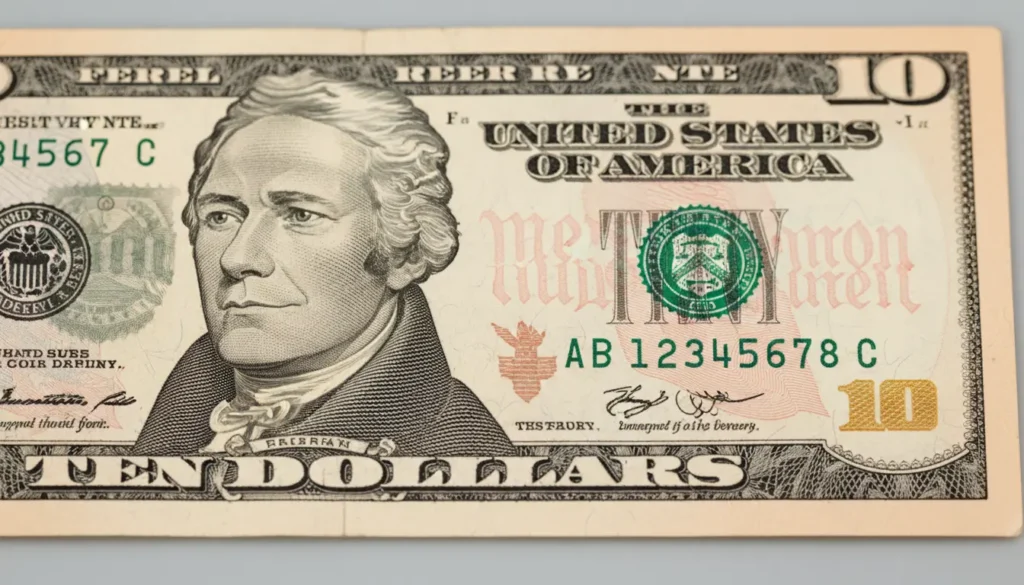
Misprinted banknotes can circulate unnoticed for years. This guide explains practical steps to identify misprinted $10 bills still in circulation and what to do if you find one.
Why misprinted $10 bills still appear in circulation
Printing millions of banknotes is a high-volume process that can produce occasional errors. Most errors are caught and removed at printing facilities, but some misprinted $10 bills make it into general use.
Understanding why errors slip through helps you learn what to look for and how to tell a genuine misprint from damage or counterfeit notes.
Common types of misprinted $10 bills
Errors vary by type and appearance. Recognizing the common categories will speed identification.
- Off-center printing — Designs shifted left, right, up, or down so borders or serial numbers are misaligned.
- Ink smears and streaks — Excess or missing ink that creates blotches or thin areas in portraits and text.
- Missing features — Portions of the design are absent, such as a missing Treasury seal or serial numbers.
- Double print — Slightly misaligned duplicate images or text from multiple impressions.
- Back-over-front errors — Printing from one side overlaps the other side, often seen as ghosting or misregistration.
- Cutting errors — Bills are cut too large or too small, sometimes joined to parts of adjacent notes.
How to tell a misprint from normal wear or a counterfeit
Wear and tear can mimic misprints. Counterfeits also try to imitate misprints to mislead buyers. Use these checks to differentiate them.
- Check paper quality: Genuine U.S. currency uses cotton-linen blend with red and blue fibers; wear looks like thinning or folding, not missing ink blocks.
- Inspect security features: Watermark, security thread, and color-shifting ink should be present and correct.
- Look at serial numbers: If serial numbers are missing or misaligned, that suggests an error rather than wear.
- Examine under magnification: Misprints often show clean edges of ink irregularities, while counterfeit ink can sit differently on the paper surface.
How to identify misprinted $10 bills still in circulation
Use a systematic approach when you suspect a misprint. A few simple tools and steps help confirm whether a bill is a genuine error.
Tools you should have
- Magnifying loupe (10x) or a strong magnifying glass
- Bright, even light source — daylight or LED lamp
- Flat, clean surface to lay the bill on
- Reference images from trusted sources like the Bureau of Engraving and Printing (BEP)
Step-by-step inspection process
- Place the bill flat under bright light and look for design misalignment or missing elements.
- Use magnification to examine ink edges, serial numbers, and microprinting details.
- Hold the bill up to light to check the watermark and embedded security thread location.
- Compare both sides against a known genuine $10 bill or high-quality BEP images to spot discrepancies.
- Document the error with clear photos from multiple angles and note where you found the bill and when.
What to do if you find a misprinted $10 bill
Your next steps depend on whether the bill is a suspected genuine error or a damaged note. Follow these actions to protect yourself and possibly report a collectible error.
- If the bill appears genuine and contains clear, unaltered error printing, contact a reputable currency dealer or error specialist for an evaluation.
- Do not alter or attempt to clean the bill; any change can reduce value and affect authentication.
- For potential counterfeit suspicions, notify your bank or local law enforcement and consider sending the bill to the U.S. Secret Service for examination.
- If you believe the note is damaged but not a collectible error, banks typically accept defective currency and can exchange it under certain conditions.
Some misprinted U.S. bills have sold for many times face value. Errors that are clear, unaltered, and rare attract collectors and auction interest.
Real-world example: Case study of a misprinted $10 bill
A small coffee shop in Ohio received a ten-dollar bill with a pronounced ink smear across Alexander Hamilton’s portrait. The owner noticed the irregularity while giving change.
She photographed the note and compared it with images from the Bureau of Engraving and Printing. The watermark and security thread were intact, but the portrait had an offset ink streak not caused by folding.
After consulting a local currency dealer, the owner learned the bill was a genuine press error. The dealer purchased the bill for several times its face value, and the owner replaced it with standard cash.
Practical tips for everyday identification
Most people will rarely encounter a genuine misprint, but staying informed helps. Keep these practical tips in mind.
- Carry a small magnifier or use your phone camera zoom for quick checks.
- Learn the main security features of U.S. currency so you can rule out counterfeits.
- When in doubt, document the note and seek a professional opinion rather than making assumptions.
- Avoid posting photos that reveal serial numbers online; share cropped images that hide sensitive details.
Conclusion: Identifying misprinted $10 bills still in circulation
Identifying a misprinted $10 bill combines observation, simple tools, and knowledge of security features. Most errors are harmless curiosities, but some can have collectible value.
When you find a suspicious bill, inspect it carefully, document your findings, and consult experts before deciding to sell, keep, or report it.